- Home
- Events
- Investigations
- News
- OPINION
- Police/Fire/EMS
- Politics
- Sports & Schools
$135,000 Grant Awarded To Support Restoration of Vanderbilt Marine Collection
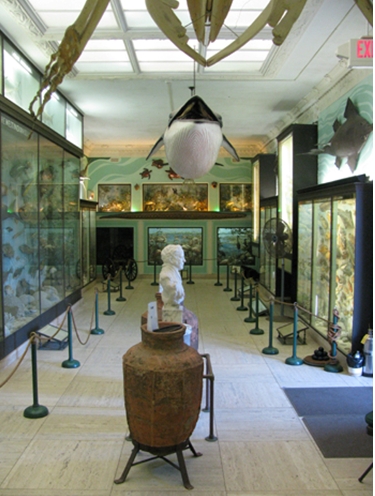 The Suffolk County Vanderbilt Museum has recently received a grant of $135,000 from The Robert D. L. Gardiner Foundation to support the restoration of the museum’s extensive marine collection, the largest privately assembled collection of sea specimens from the pre-atomic-era.
Jennifer Attonito, executive director of the foundation, said, “The Vanderbilt Museum is a Long Island gem and a major anchor of local history. We are proud to help preserve this valuable collection to benefit museum visitors and to help raise awareness of Long Island’s heritage.”
The Gardiner Foundation, established in 1987 in Hampton Bays, New York, supports the study of Long Island history, with an emphasis on Suffolk County. The Foundation was inspired by Robert David Lion Gardiner’s personal passion for New York history.
Stephanie Gress, the Vanderbilt’s director of curatorial affairs, said, “The Gardiner Foundation grant will help us to restore and preserve many rare specimens in our Marine Museum that have long needed critical attention. Our marine collection is the foundation for several key Vanderbilt education programs that serve Long Island schools.”
The Vanderbilt marine collection of 13,190 specimens is housed in the Marine Museum, Habitat and Memorial Wing. Of these, she said, 919 are invertebrates in fluid (displayed in “lots” — from two to many in a single display container); 719 dry fish specimens; 1,746 wet fish specimens in lots; and 9,806 dry marine invertebrates (shells and corals). Dry specimens are exhibited on the first floor of the Marine Museum, wet specimens on the second floor.
The two largest marine specimens are a 32-foot whale shark — caught in 1935 and restored in 2008 with a federal Save America’s Treasures grant — and an imposing manta ray, caught in 1916 and restored many years ago, with a 16.5-foot wingspan. William K. Vanderbilt II called it the “Sea Devil.”
Gress said cartilaginous fish, such as sharks and rays, which have spines of cartilage instead of bone, are the most difficult to preserve. Another problem is the age of the collection — many of Mr. Vanderbilt’s earliest specimens are nearly one hundred years old. When preservation fluid (ethanol and distilled water) in specimen containers degrades the wax seals, comes in contact with air, and evaporates, specimens can decompose, she said.
Robert David Lion Gardiner was, until his death in August 2004, the 16th Lord of the Manor of Gardiner’s Island, New York, located in Gardiner’s Bay between the North and South forks of Long Island. The Gardiner family and its descendants have owned Gardiner’s Island since 1639, obtained as part of a royal grant from King Charles I of England.
By Patrick Keeffe

Facebook Comments must be signed into Facebook



.png)

You must be logged in to post a comment Login